Not aesthetic rebellion. Not permanent outrage. A change substantial enough to alter who carries risk, how power answers, where responsibility lives, and what another human being encounters tomorrow.
Welcome to the AllianceYou’re sitting at the threshold for consequential change.
Enter the
Revolutionary
Realignment.
Come as you are. Bring your history, convictions, questions, loyalties, doubts, and differences. The invitation is not to become identical. It is to change what becomes possible between us.
Cross the threshold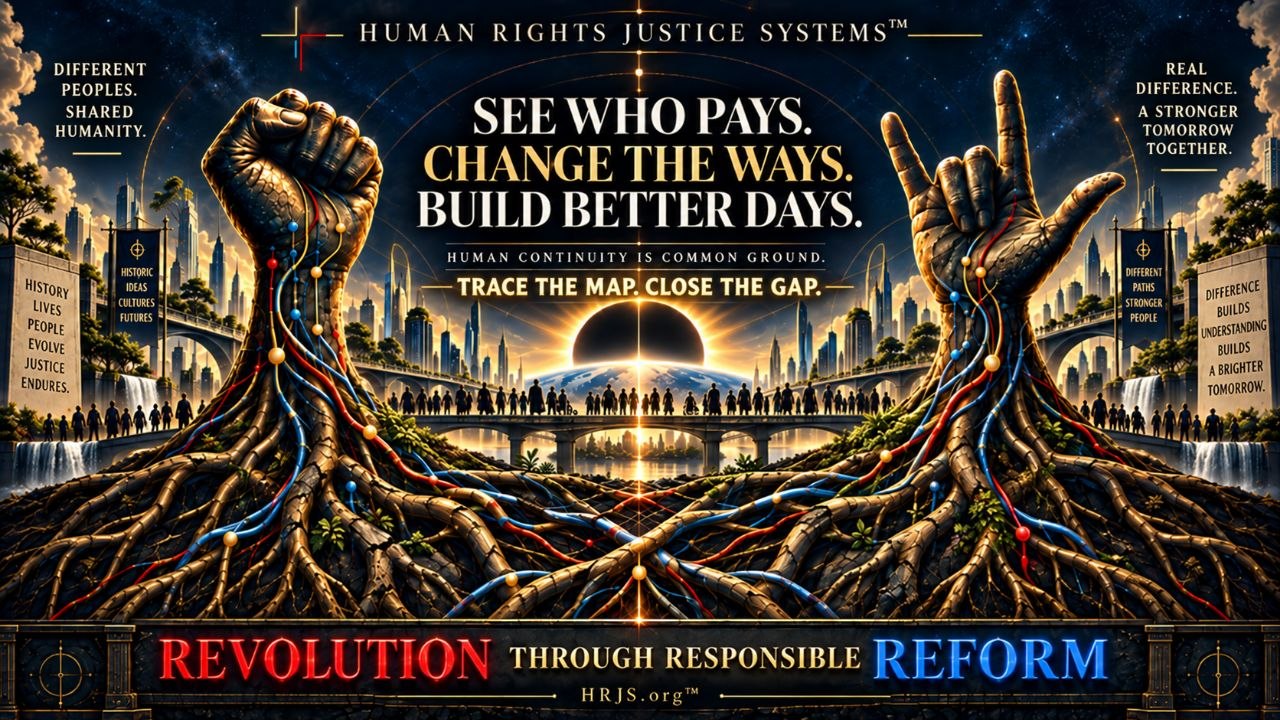
We came through darkness, but we refused to become chaotic. We will turn consequences into structure; pain into language; survival into doctrine; doctrine into community impact; and community impact into legacy.
Forthcoming anthem
The realignment will have an anthem.
An original work by R.J. Knox™ arrives
The music will carry the emotional architecture of the Revolutionary Realignment: consequential change without compulsory sameness, conviction without permanent enemy camps, and human continuity as the ground beneath our differences.
Countdown to release
The Revolutionary Realignment anthem by R.J. Knox is scheduled for release on October 31, 2026, at 3:00 p.m. Central Time.
Temporary soundtrack
Humans Breathe (Just Like Us)
A temporary soundtrack for the Revolutionary Realignment.
This song begins from an almost embarrassingly simple fact: the people we fear, oppose, judge, govern, investigate, work beside, argue with, and sometimes fail are still human beings breathing the same air. That recognition is not offered as innocence, agreement, or surrender. It is the ground from which evidence, accountability, boundaries, and consequential action can proceed without requiring another person’s erasure.
The production carries that argument through contradiction. A heavy street-rap frame surrounds language about human need, evidence, restraint, institutional failure, and responsibility. The voice does not become softer in order to advocate for somebody else. It remains forceful. The proposition is that recognizing another person’s humanity is not weakness, and that disciplined strength can ask harder questions precisely because it does not need dehumanization to sustain itself.
Across the record, intuition is asked to meet evidence, individual incidents are followed into patterns, and power is measured by what happens to the person absorbing the consequence. The repeated phrase “just like us” becomes less a plea for sameness than a reminder of shared stakes: people need air, food, dignity, continuity, and some reasonable chance of being seen before a system, tribe, institution, or story decides they are disposable.
For the Revolutionary Realignment, the song functions as a temporary musical thesis: remain distinct, examine the record, confront what causes harm, and do not lose sight of the human being while doing it. Realignment does not require everybody to become the same. It asks whether we can become strong enough to remain different without making somebody else’s disappearance the price of belonging.
01 / The distinction
Change the relationship.
Do not erase the person.
Not erased identities. People, groups, and institutions remain distinct. What changes is the arrangement between them: more visibility, better handoffs, shared responsibility, honest boundaries, and fewer humans lost inside the gaps.
02 / Three public movements
Trace the map.
Close the gap.
See who pays.
Trace policy, procedure, delay, and institutional failure all the way to the people who absorb the consequence.
Change the ways.
Redesign relationships between authority, responsibility, evidence, process, and the human beings moving through them.
Build better days.
Convert accountability into durable learning so the next person inherits more continuity, not merely another explanation—and so the society we leave behind protects the people we love, those we may never understand or love, our children, and the animals who share and depend upon our world.
03 / The broad invitation
Every group enters with something worth preserving—and something worth examining.
Unity is not agreement without remainder. It is the decision that difference will not cancel our obligations to one another.
This realignment does not ask conservatives to stop valuing order, progressives to stop examining inequity, libertarians to stop defending freedom, institutions to surrender standards, advocates to soften the truth, or communities to forget what they survived. It asks every group to place its values beside their human consequences—and remain present long enough to see both.
Nobody receives moral immunity. Nobody is required to enter through humiliation. Power remains accountable. Individuals remain responsible. History remains visible. Movement remains possible.
04 / Who this speaks to
Different lives.
United stakes.
Individuals & families
Safety, dignity, continuity, voice, and a future that remains reachable.
Frontline workers
Tools, protection, truthful records, and authority connected to responsibility.
Communities
Belonging without enforced sameness; cooperation without surrendered self-determination.
Institutions
Clear standards, visible ownership, defensible process, correction, and earned public trust.
Public-safety professionals
Legitimate authority, human judgment, better handoffs, accountability, and safer outcomes.
Advocates & reformers
Courage to confront harm without making permanent enemies the organizing requirement.
Faith & moral communities
Conscience, responsibility, mercy, truth, repair, and protection of the vulnerable.
Skeptics & dissenters
The right to question the map, test the evidence, and remain human while disagreeing.
05 / No self-erasure required
You do not have to disappear to belong here.
Keep your name. Keep your faith or your doubt. Keep your culture, profession, community, political memory, and the experiences that taught you to be careful. Bring the boundary. Bring the disagreement. Bring the evidence that complicates the room.
What cannot remain untouched is any arrangement requiring another person’s invisibility, exhaustion, humiliation, or disposability. The realignment begins when identity stops being a license to avoid consequence—and accountability stops being a license to deny humanity.
Shared humanity is not the end of difference. It is the ground beneath it.
06 / The HRJS architecture
Five recurring layers.
One connected system.
The Revolutionary Realignment is the public threshold into Human Rights Justice Systems. It names the relationship that holds the wider architecture together: people may remain different while accepting shared responsibility for the human consequences produced between them.
Start with the person carrying the consequence. Establish the record. Map the system around it. Decide what response follows. Translate the learning into something usable.
The six-question method
A shared sequence for disciplined inquiry.
- What happened?
- Who could act?
- Where did the handoff break?
- Who absorbed the consequence?
- What remained unseen?
- What should change next?
Real difference.
Shared humanity.
A stronger tomorrow together.
Revolutionary Realignment temporary soundtrack · Loading soundtrackHumans Breathe (Just Like Us)