The human
What the person was carrying before, during, and after the institutional event—and what remained necessary while formal processes continued.
Living record · Consequential systems · Human continuity
The place where institutional architecture is examined from the position of the human being required to live through its decisions, delays, gaps, and consequences.
The field-study lenses
A checkpoint is not proof that someone should have known the future. It identifies a point where another outcome was reasonably possible—not hindsight certainty.
01 / The field
Policies are usually described from the point of decision. Procedures are usually measured from the point of availability. Human Systems Field Study examines what happens after both: whether the information moved, whether a handoff held, whether responsibility remained visible, and whether the person affected retained enough continuity to participate in the remedy supposedly available to them.
This is neither grievance as spectacle nor survival as mythology. It is a disciplined record of how human life and institutional process interact under pressure—and what recurring consequences may reveal about the structure that produced them.
02 / The declaration
03 / What remains in view
What the person was carrying before, during, and after the institutional event—and what remained necessary while formal processes continued.
What can be established through chronology, documents, communication, observable sequence, and the difference between evidence and inference.
Where authority, information, ownership, procedure, and corrective capacity aligned—and where they separated across institutional boundaries.
How one decision or failed handoff traveled into income, housing, transportation, healthcare, family stability, and the ability to remain inside the process.
Field study does not convert every hardship into institutional wrongdoing. It keeps fact, inference, uncertainty, power, and consequence distinct enough to examine responsibly.
04 / Field preview 01
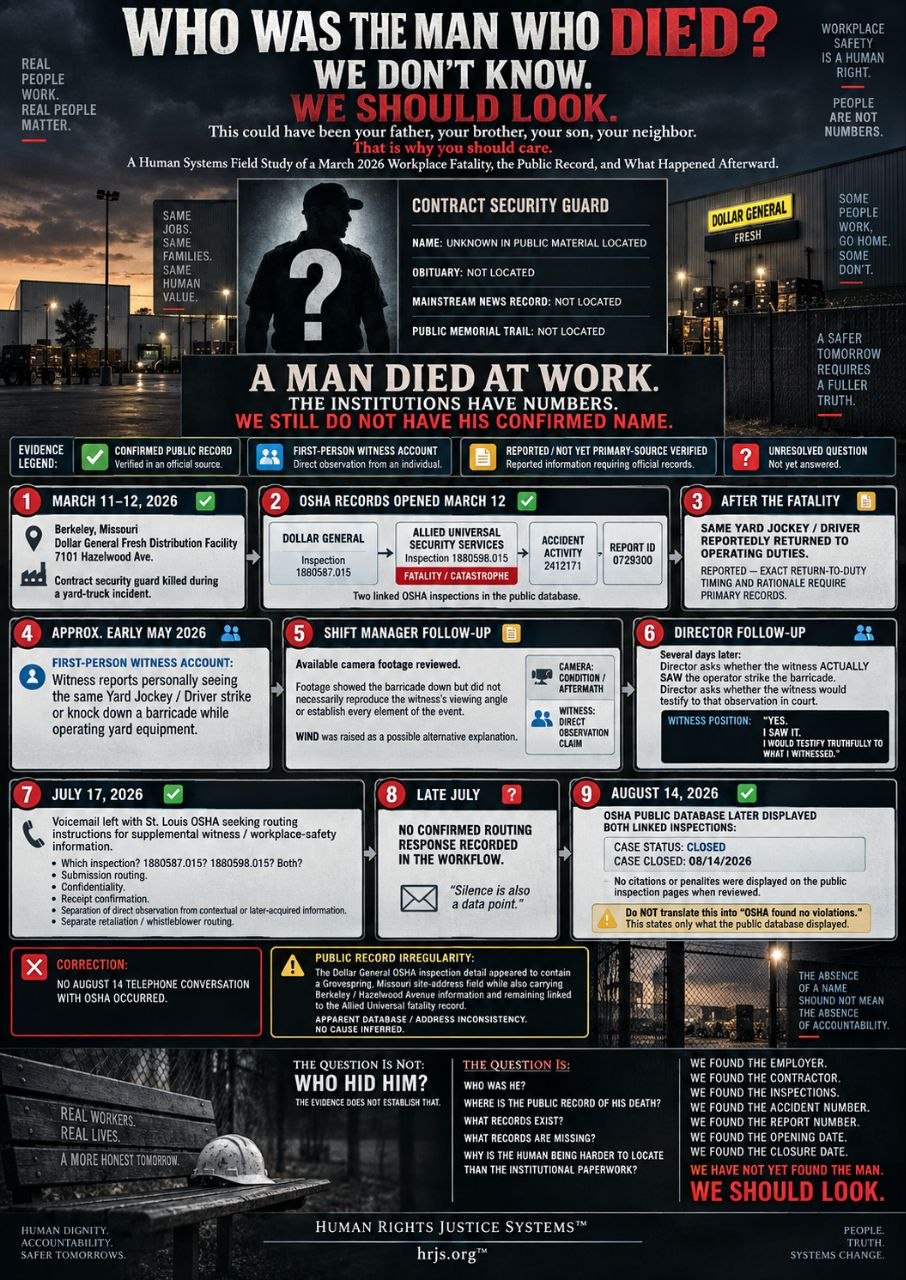
This opening field study begins with a March 2026 workplace fatality reported at the Dollar General Fresh distribution facility in Berkeley, Missouri. It does not claim to complete the record. It shows why the record must be pursued carefully: the employer, contractor, incident, inspection activity, and dates may become visible before the name, life, family, and public memory of the person who died.
What the two reports establish
Both local reports describe police and emergency personnel responding late on March 11, 2026, after a yard truck reportedly struck a contract security guard at the Berkeley distribution facility shortly before the guard’s shift. Real STL News reported that the guard died from his injuries. VOP News STL reported, through anonymous-source accounts, that employees appeared shaken, operations continued during the response, and further official details had not yet been released.
These accounts are an entry point—not a substitute for official records. They establish the public reporting baseline while leaving identity, complete sequence, decision ownership, and the institutional aftermath for further examination.
The developing study
The larger field study will use records, lived experience, public sources, and carefully bounded analysis to examine how consequences travel across systems. Each institution will be evaluated on its own evidence; the purpose is to make handoffs, gaps, and patterns visible without collapsing distinct events into a conclusion the record cannot support.
Dollar General operations, leadership, safety, employment records, and the institutional response surrounding consequential workplace events.
The Matrix leave-administration interface and what happens when medical need, employment status, documentation, and decision ownership cross organizational boundaries.
Police contact, incident response, public records, evidentiary continuity, and the handoff between private institutions and public authority.
Care, assessment, documentation, privacy, crisis navigation, and the consequences created when clinical information must travel into administrative processes.
How eligibility, timing, documentation, communication, and institutional delay interact when a person is trying to preserve shelter during cascading instability.
The same person may be required to carry facts, deadlines, records, and consequences between institutions that do not share a complete view of one another.
The study asks not only what each institution did, but what happened to the human being required to move between them while carrying the consequence.
05 / Forthcoming cross-institutional case study
Scheduled publication · By September 11, 2026
I am developing a cross-institutional case study tracing one consequential employment and leave-administration matter across its wider authority structure—from frontline operations and employer administration through an external leave administrator, upward toward enterprise governance and the board, and back down to the person required to live with the outcome.
The study will examine how authority, information, responsibility, and requests for correction moved—or failed to move—across institutional boundaries. It will also consider several bifurcated pathways and apparent shadow processes that raise fundamental questions about whether the stated procedures operated as represented, who possessed meaningful authority at each threshold, and whether the available channels carried genuine procedural integrity or corrective weight.
A central focus will be the inverse movement of escalation and consequence. As questions, evidence, and requests for correction traveled upward through increasingly senior levels of authority, the practical consequences continued moving downward and concentrating upon me. Those consequences included severe financial strain, delayed or blocked access to essential resources, expanding administrative burdens, and diminished capacity to stabilize daily life while simultaneously preserving the record and pursuing remedy.
The resulting pressure extended into the conditions necessary for human continuity, including housing, transportation, healthcare access, family stability, and meaningful participation in the processes presented as avenues for correction.
The completed study will include visual diagrams, an authority-chain map, analysis of the institutional intersections, and a compressed, selectively redacted presentation of an underlying record totaling approximately 2,600 pages. The published material will protect private information while preserving the chronology, evidentiary relationships, and unresolved institutional questions necessary to examine the matter responsibly.
Authority traveled upward. Consequence traveled downward.
One person experienced the concentrated consequences. The authority, information, and responsibility surrounding them were distributed across an entire institutional architecture.
Human Systems Study
Stage One — Limited Disclosure
What happens when responsibility, accountability, and actual decision-making authority stop occupying the same level of an institution?
Stage One releases September 18, 2026 at 5:00 PM Central Time.
Stage One will trace an escalation pathway from frontline operations through progressively higher levels of institutional authority, then examine how decisions, responsibility, and consequences travel back down the chain.
The bounded case study will examine one employer and one third-party leave administrator. It will distinguish formal authority from functional authority, identify where decision-making power and responsibility appeared to sit, and examine what changed when the matter crossed organizational boundaries.
Individuals will be identified by institutional role or function only. The analysis will keep documented events, institutional structure, inference, and unresolved questions visibly distinct. This announcement does not publish the full authority map, private correspondence, protected information, or unpublished evidence—and it does not present disputed matters as established facts.
The September 18 presentation will walk viewers through the escalation pathway, authority structure, employer–administrator relationship, institutional boundaries, and the movement of consequence back toward the employee.
Follow the escalation. Map the authority. Track the consequence.Stage Two will be announced during the September 18 presentation.06 / Section anthem
Command is not the absence of pressure. It is the refusal to let pressure choose what kind of person survives it.
He who fights with monsters should be careful lest he thereby become a monster. And when you gaze long into an abyss, the abyss also gazes into you.
The song moves from a spoken legacy vow into the compressed rhythm of work, fatherhood, financial instability, institutional silence, intimidation, and documentary persistence. Its protagonist does not ask suffering to become a credential. He measures strength by what remained protected: his children, his future, his restraint, and his capacity to turn experience into a record other people can use.
Nietzsche’s warning supplies the ethical tension beneath the title. A field study must be willing to look directly at harmful conduct, institutional failure, and the reactions they produce without allowing injury to authorize dehumanization, vengeance, or unexamined certainty. To gaze without becoming is to keep the record clear, the boundary intact, and one’s own shadow inside the examination. That is command without collapse.
The chorus rejects erasure through exhaustion. The verses answer chaos with sequence, and the forensic bridge strips away halo, villain, vengeance, and martyrdom until only the record remains. Within HRJS, that movement connects personal survival to institutional accountability: consequence becomes evidence, evidence reveals architecture, and architecture becomes a basis for responsible reform rather than an occupation by violence.
No mythology. No martyrdom. No worship of survival. Just the record. Just the sequence. Just the architecture.
06 / The study within HRJS
The field study supplies the human and evidentiary ground beneath the wider HRJS architecture. It asks what continuity required, what the record can establish, what power was able to see or correct, and what must change so the same gap does not simply recruit another person.
Revolution through responsible reform.