Visible stability is not the same thing as resilience.
73% of adults say they are doing okay financially or living comfortably. Yet only 63% could cover a hypothetical $400 emergency with cash or its equivalent.
FACT · S01 · Federal Reserve, 2026 Revolution through responsible reform
 Evidence / home
Financial pressure rarely arrives as one clean category. It moves through housing, health, transportation, work, family life, and the capacity to respond when something breaks.
73% of adults say they are doing okay financially or living comfortably. Yet only 63% could cover a hypothetical $400 emergency with cash or its equivalent.
FACT · S01 · Federal Reserve, 202691% of adults identify price increases as at least a minor financial concern.
FACT · S01 · Federal Reserve, 202630% reported a major vehicle repair or replacement, 22% a major home or appliance repair, and 21% a major medical expense.
FACT · S01 · Federal Reserve, 202649.7% of renter households for whom burden was calculated spent more than 30% of income on housing costs.
FACT · S06 · U.S. Census Bureau, 202428% struggled to pay bills in the prior month, while 26% went without some medical care because they could not afford it.
FACT · S03 · Federal Reserve, 2026Could this happen to you?
Better question: Which protections currently prevent it from happening to you?See the researchC01–C06 are FACT claims from the Federal Reserve's 2025 Survey of Household Economics and Decisionmaking. C08 is a FACT claim from the U.S. Census Bureau's renter cost-burden analysis.
Federal Reserve — Economic Well-Being of U.S. Households in 2025 ↗
U.S. Census Bureau — Nearly Half of Renter Households Are Cost-Burdened ↗
Evidence / common ground
A shared human problem does not create a shared starting line. These figures describe measured differences in financial buffers—not causes, character, behavior, or anyone's individual destiny.
Three-month emergency savings were reported by 21% of households below $25,000 in income, compared with 75% of households at $100,000 or more.
FACT · S02 · Federal Reserve, 202637% of adults ages 18–29 reported three months of emergency savings, compared with 71% of adults age 60 and older.
FACT · S02 · Federal Reserve, 202640% of adults with disabilities reported three months of emergency savings, compared with 60% of adults without disabilities.
FACT · S02 · Federal Reserve, 2026Three-month savings were reported by 38% of Black adults, 43% of Hispanic adults, 61% of White adults, and 68% of Asian adults.
FACT · S02 · Federal Reserve, 202658% of LGBTQ+ adults reported postponing or skipping needed health care because of cost, compared with 38% of non-LGBTQ+ adults.
FACT · S08 · KFF, 2026Same category of pressure. Different exposure.
Common ground begins when we stop using difference as a shortcut for certainty.See the Common Ground researchC11–C14 are FACT claims from the Federal Reserve, KFF, and Pew Research Center. The figures describe reported conditions and positions; they do not establish a person's character, cause, or worldview.
Federal Reserve — Savings and Investments ↗
Common Ground soundtrack
R.J. Knox™
A hard Southern gangsta-rap homecoming record that turns street survival into systems analysis. R.J. Knox returns carrying scars, receipts, and a blueprint for tracing authority, consequence, and human impact.
The governing idea
The transformation HRJS seeks is neither passive accommodation nor indiscriminate rupture. It is change disciplined by evidence, dignity, accountability, continuity, and the responsibility to preserve people while systems learn. Reform becomes revolutionary when it reaches the structure that keeps reproducing the consequence.
See the operating commitments ↘02 / The public philosophy
Across difference, a common human stake
This is not a demand for sameness, partisan conformity, or indiscriminate rupture. It is a civic commitment to transform what causes preventable harm while protecting people through the transition—and to make power, process, and responsibility worthy of the human lives they affect.
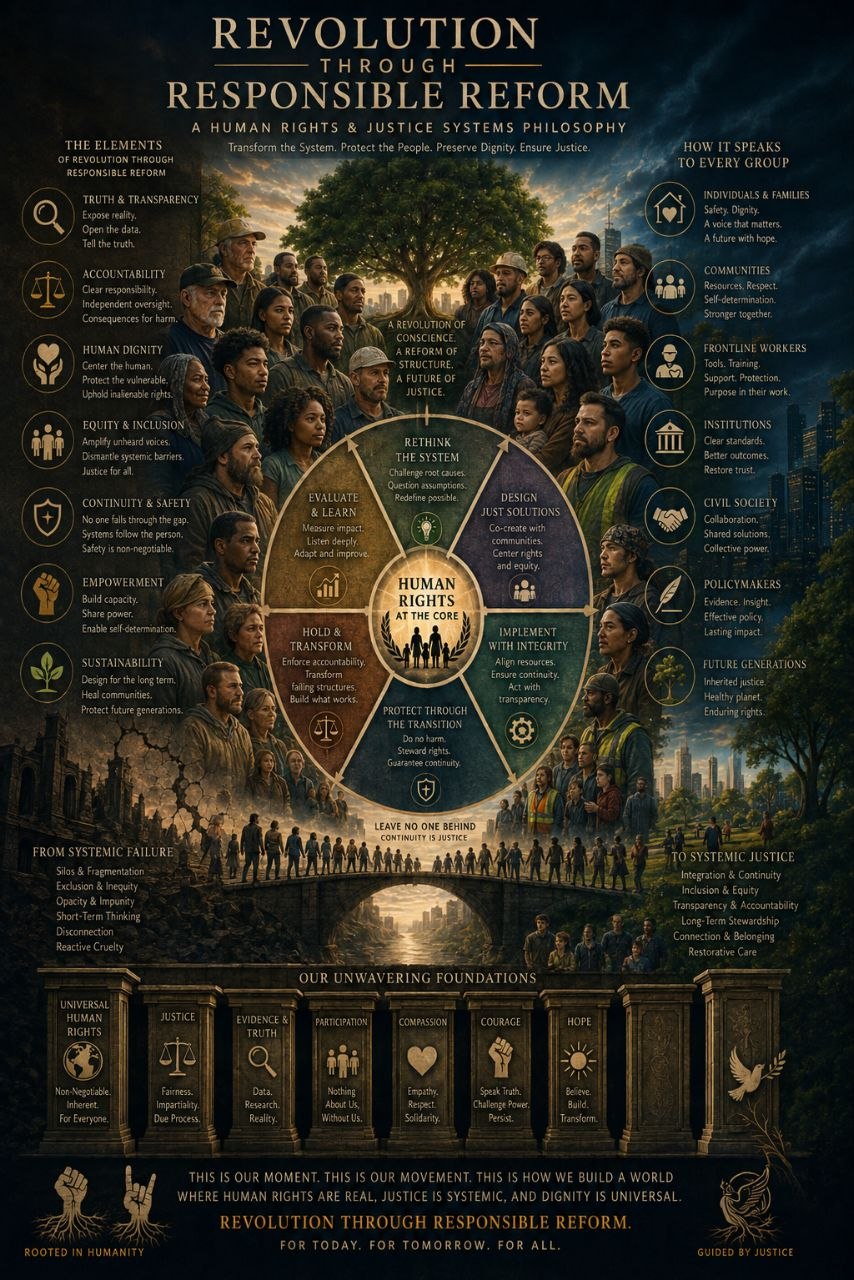
Transform the system. Protect the people. Preserve dignity. Ensure justice. HRJS treats those obligations as one coherent discipline.
Open the record, name reality clearly, and make consequential decisions understandable.
Connect authority to responsibility, oversight, correction, and the consequences power creates.
Protect the person without abandoning rigor, evidence, standards, or shared responsibility.
Bring affected voices into view and confront barriers that make fair process unevenly accessible.
Prevent a failed handoff from becoming a cascading loss of housing, health, mobility, or hope.
Build capacity, share power responsibly, and design changes capable of protecting future generations.
Every background · United concerns
Across race, culture, class, faith, gender, age, ability, profession, political tradition, and place, people encounter institutions from different positions. Yet the underlying concerns remain shared: safety, dignity, continuity, fair process, accountable power, and a future worth inheriting.
How HRJS knows what it knows
Pattern recognition can guide inquiry. A pattern does not automatically prove cause.
03 / Operating commitments
Protecting the human capacity to remain housed, connected, informed, mobile, healthy, and capable of participating when pressure or institutional disruption arrives.
Aligning authority, responsibility, evidence, fair process, and meaningful access so power remains answerable to the consequences it creates.
Turning hard-won insight into clearer ownership, stronger handoffs, durable safeguards, and systems capable of learning before failure becomes inheritance.
04 / Accountability in every direction
A credible culture of accountability asks more of power without pretending the rest of us have no obligations to ourselves, one another, or the systems we help sustain.
The greater the authority, the greater the obligation to remain visible, reviewable, and connected to human consequence.
Accountability begins with the courage to examine our own formation, choices, blind spots, and capacity to cause harm.
Fair process requires reciprocal dignity, truthful participation, proportionate judgment, and responsibility in relationship.
Responsibility must survive the boundary between departments, professions, institutions, and the people moving through them.
05 / The shared exposure
Many people are closer to institutional instability than they realize. A single interruption can travel across systems faster than any one department can see—and reduce the very capacity a person needs to seek correction.
The point is not inevitability. The point is interdependence.
Reconstruct how an initially manageable issue becomes a larger human or institutional failure through accumulated decisions, delays, handoffs, and lost corrective opportunities.
When several offices, vendors, managers, or systems each control only part of a process, map where responsibility is distributed and where ownership disappears between them.
Identify who could decide, who could act, who held information, and where formal authority separated from practical control.
Carry one consequential record across professional and institutional languages without losing the human being or the evidence.
09 / Founder & executive strategist
Human Rights Justice Systems is founded and led by Harold R. J. Sloke, an executive strategist whose work connects public administration, human services and social systems, frontline logistics and operations leadership, organizational accountability, and strategic systems thinking. His role is not to ask people to share one worldview, but to help locate the human stakes, responsibilities, and reform possibilities that different worldviews can still hold in common.
My work sits at the intersection of human consequence, institutional process, evidence, systems design, and cultural translation. I move between disciplines because the problems themselves do.
A workplace event may involve logistics, safety, HR, law, psychology, organizational politics, family continuity, and public narrative at the same time. Treating each as unrelated can hide the system connecting them.
Identity in motion · Translation without self-erasure
“Different room. Different code. Same spine.”
The song traces the difference between adaptation and surrender. It follows someone who learned to read class, danger, hierarchy, and institutional codes for survival—then transformed that vigilance into translation, leadership, systems thinking, and art. The language may change with the room; the underlying truth and identity do not.
Its deeper claim is about governed power. Awareness creates space between anger and action, allowing strength to appear as restraint, self-command, and deliberate choice rather than humiliation or violence.
Early public work · Washington, D.C. · 2012
At 22, Harold appeared with U.S. Senator Mary Landrieu as a former foster-youth intern in the office of U.S. Senator Roy Blunt. The conversation brought national attention to young people aging out of care, educational instability, and the need for policy informed by the people who have lived through the system.
Harold discussed moving through twelve high schools and the teacher who helped reconstruct credits that had been lost across transitions. Senator Landrieu also highlighted a records-continuity reform idea rooted in that experience. It is an early public expression of the work HRJS carries forward today: translating human consequence into questions of policy, institutional responsibility, and better system design.
A contemporaneous CCAI account identifies Harold as a member of the 2012 Foster Youth Internship class and recognizes educator Karen Parker, whose intervention helped preserve his path to graduation and became an enduring example of how one person can alter an institutional trajectory.
Harold briefed Senator Roy Blunt on educational records lost across foster-care transitions and released his contribution to the CCAI report.
HuffPost reported that Blunt joined the Uninterrupted Scholars Act as a co-sponsor after hearing Harold’s account. A bipartisan Senate measure followed.
After President Barack Obama signed the legislation, The Post and Courier profiled Harold as a public face of the new federal law.
The law removed a federal privacy barrier so child-welfare professionals could access educational records—helping foster youth remain enrolled, retain earned credits, and continue toward graduation.
2012 policy report · Authored contribution
In Preventing Crossover from Foster Care into the Criminal Justice System, Harold combined research with firsthand experience to show how instability, congregate-care conditions, interrupted education, and bias in detention decisions can move a young person from one public system into another.
The paper advanced eleven policy recommendations across four connected intervention points. Its central argument was structural: youth outcomes cannot be separated from placement decisions, the quality of institutional care, continuity across records and relationships, or the way authority is exercised when a young person enters crisis.
Family discovery, permanent placement, and trusted mentoring before isolation compounds.
Better placement judgment, accountable supervision, and alternatives to criminalizing ordinary conflict.
Timely transfer of records, proper credit recognition, and uninterrupted access to school.
Community support, informed advocacy, and interventions designed to keep crisis from becoming custody.
More than a decade later, that same boundary-spanning concern remains visible in HRJS: a failed handoff is never merely administrative when a person’s education, safety, family connection, or liberty is at stake.
Read Harold’s contribution · Report pages 4–17Current threshold work · Foundational essay
A study of the survivor whose visible competence can obscure the absence of durable cover—and the movement from solitary defense toward integration, reciprocity, accountability, and legacy.
Enter the perspective10 / Founding progression
I came through darkness, but I refused to become chaotic. I will turn consequences into structure; pain into language; survival into doctrine; doctrine into community impact; and community impact into legacy.
Harold R. J. Sloke · Founder, Human Rights Justice Systems
11 / Consultation & Build Support
Practical advisory support for individuals, professionals, leaders, and organizations working through complex systems, documentation, communication, sequencing, professional presentation, or institutional navigation.